

August 26, 2026
What is a Milk-to-Foam Cleanser?
A milk-to-foam cleanser shifts from milk to lather in one step. We explain the surfactants and pH that actually decide whether it works.
Milk-to-Foam Cleansing: What the Science Actually Says
>A milk-to-foam cleanser goes on as a soft, lotion-like milk, then turns into lather once you add water and massage it in. The idea is to fold two cleansing steps, an oil-based emulsifying step and a surfactant-based foaming step, into a single product, so you get an oil cleanser's makeup removal without reaching for a separate bottle. Whether that actually works has less to do with the texture change itself and more to do with which surfactants are doing the foaming and what the finished pH looks like. We'll walk through both.
BTTR was launched in March 2026 by Son Ho-cheol, founder of Korean fashion brand SATUR, together with beauty experts. Source
>What a Milk-to-Foam Formula Actually Do
A standard cleansing milk leans on oils and emulsifiers. That combination is good at breaking down makeup and sebum, but because it carries a lower share of true cleansing surfactants, it can leave a slightly filmy residue after rinsing. A cleansing foam works the other way: a high concentration of cleansing surfactants gets you a squeaky-clean finish, but on its own it often can't fully dissolve heavy makeup or sunscreen.
A milk-to-foam formula sequences both functions in one product. Applied to dry skin, the milk phase emulsifies makeup and oil first. Once water is added and you continue massaging, the cleansing surfactants activate and convert the product into lather that carries the loosened residue away. In practice, it compresses what an oil cleanser and a foam cleanser would normally do across two steps into one.
Why the Texture Shifts from Milk to Foam
The shift happens because of how surfactants behave differently with and without water. For oil-based residue like makeup or sebum to rinse away, it first has to be broken into fine, water-dispersible droplets, a process called emulsification. In a milk-to-foam formula, the oil-binding, emulsifying ingredients act first on dry skin. Once water is introduced, the surfactants responsible for foam lower the surface tension of the mixture and whip it into lather.
According to mulgeo's cleansing guide, foam is a texture that maximizes a surfactant's cleansing power: a fuller lather increases surface area, giving it more contact with residue so it emulsifies and lifts away faster. That same cleansing strength is a double-edged sword, though, since foam can strip natural moisturizing factors along with dirt and oil. This is the exact problem a milk-to-foam formula is built to manage. Because the milk phase clears away oil before the foam stage begins, you generally need less rubbing and less contact time with the foaming step, which lowers the odds of over-cleansing.
Can It Replace Double Cleansing?
Whether a milk-to-foam cleanser can fully stand in for double cleansing depends on how much makeup or sunscreen you're wearing. Heavier, oil-based residue, waterproof sunscreen or full-coverage color makeup, needs a properly working emulsification stage to come off cleanly. Namu Wiki's entry on cleansing oil points out that soap or foam cleansers can eventually remove makeup if you scrub hard enough, but that approach irritates skin and can dry it out, which becomes a trigger for breakouts. So leaning on foam strength alone, without a real emulsifying step, isn't a good substitute. On lighter days, a bit of makeup or just sunscreen, a single round with a milk-to-foam cleanser can reasonably match what double cleansing would achieve.
The Two Things That Actually Determine Effectiveness: pH and Surfactants
The milk-to-foam texture change is a nice mechanic, but what matters more is which cleansing surfactants show up in the foam stage and where the finished formula lands on pH. Dermatologist Noh Seong-min of Benjamin Dermatology Clinic explained to Harper's Bazaar Korea that skin's normal pH sits at 4.5 to 5.5, a mildly acidic range, and that a cleanser formulated within that range tends to put less stress on the skin barrier, though he added that this isn't the right answer in every situation. In other words, an "acidic" label on its own isn't enough. It matters just as much what type of surfactant is doing the cleansing and how strong that cleansing action is.
medireturn's breakdown frames the trade-off in similar terms: skin's surface naturally sits around pH 4.5 to 6.5, and a cleanser's pH shapes the balance between cleansing strength and barrier protection. A more acidic cleanser is gentler but weaker at cutting through oil, while a more alkaline one cleans more aggressively but requires deliberate moisture replenishment afterward. The same source also notes that a cleanser's pH affects skin only for the moment of washing, not permanently, and that healthy skin naturally returns to its own baseline pH within roughly 30 minutes to an hour after cleansing. That makes a product's pH label less useful as a standalone verdict than simply watching for tightness or irritation with repeated use.
Which surfactant converts the milk into foam is worth checking too. Yoo Sun-hee, an adjunct professor of cosmetology at Konkuk University's Graduate School of Education, told Harper's Bazaar Korea that cleansing surfactants are mild enough that some are even used to wash laboratory cell cultures. She also cautioned that skipping a thorough water rinse after using this type of surfactant can leave residue that isn't visible to the eye, which can clog pores and lead to breakouts. For a milk-to-foam cleanser, that means the finishing rinse with lukewarm water carries as much weight as the formula itself.
Choosing a Milk-to-Foam Cleanser If You Have Sensitive Skin
If your skin runs sensitive, these are the checkpoints worth looking at before choosing a milk-to-foam product:
Whether the foaming-stage surfactant is an amino acid or betaine-based type rather than a harsher sulfate like SLS
Whether the finished formula's pH is disclosed and falls in the mildly acidic range (roughly 4.5 to 6.5)
How much the milk stage's moisturizing ingredients (ceramides, hyaluronic acid, and similar humectants) offset tightness after the foaming step
Whether the product states clearly that it's formulated to handle oil-heavy residue like sunscreen or waterproof makeup
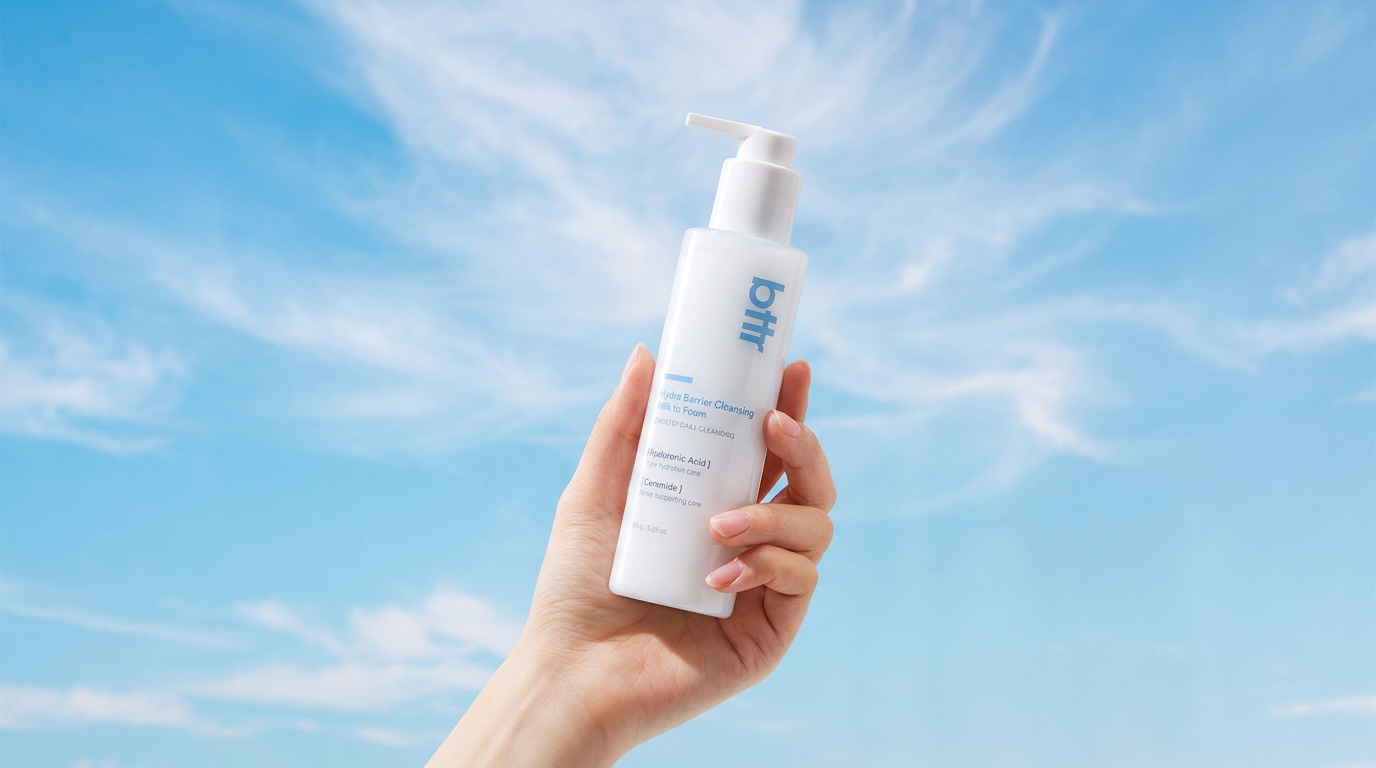
We built our Hydra Barrier Cleansing Milk to Foam around this checklist, alongside a mini size for anyone who wants to test the formula on their own skin before committing to a full-size bottle. Brands like Dr.G, beplain, ROUND LAB, BANILA CO, and make p:rem each take their own approach to gentle, one-step cleansing, so comparing ingredient lists and disclosed pH directly is still the most reliable way to match a formula to how much makeup you actually wear.
![[썬클렌저] 하이드라 베리어 클렌징 밀크 투 폼 150g](https://bttr.co.kr/web/product/big/202606/545ad000ac061c6a131ee813605b2f1a.png)
FAQ
Do I need a toner right after using a milk-to-foam cleanser to rebalance pH?
If the cleanser itself is labeled mildly acidic, your skin's pH shouldn't swing far after rinsing. Since the process still includes a foaming step, though, applying a toner or essence within about 30 seconds of rinsing can help offset any tightness.
Can I use a milk-to-foam cleanser in the morning?
Mornings often only need to clear away whatever night cream is left on skin, so a milk-to-foam formula or a gentle foam alone is usually enough. If you notice tightness afterward, switching to a lukewarm water rinse on those days is a reasonable alternative.
What if my skin still feels under-cleansed after using a milk-to-foam product?
That usually points to too little massage time or an incomplete emulsification step. Massaging the milk into dry skin for at least 30 seconds before adding water and working it into foam tends to change the outcome noticeably.
Should I avoid a milk-to-foam cleanser that doesn't disclose an acidic pH?
Not disclosing a pH doesn't automatically mean a product is harsh, but if your skin is sensitive, it's more reliable to prioritize products that do list their pH and then confirm for yourself, over repeated use, whether you notice tightness or irritation.
How is a milk-to-foam cleanser different from a cleansing water?
Cleansing water relies on surfactants dispersed in water that form micelles to lift away residue, and it doesn't foam at all. A milk-to-foam cleanser works through a sequential emulsify-then-foam process, so the underlying cleansing mechanism is different, not just the finish.
